
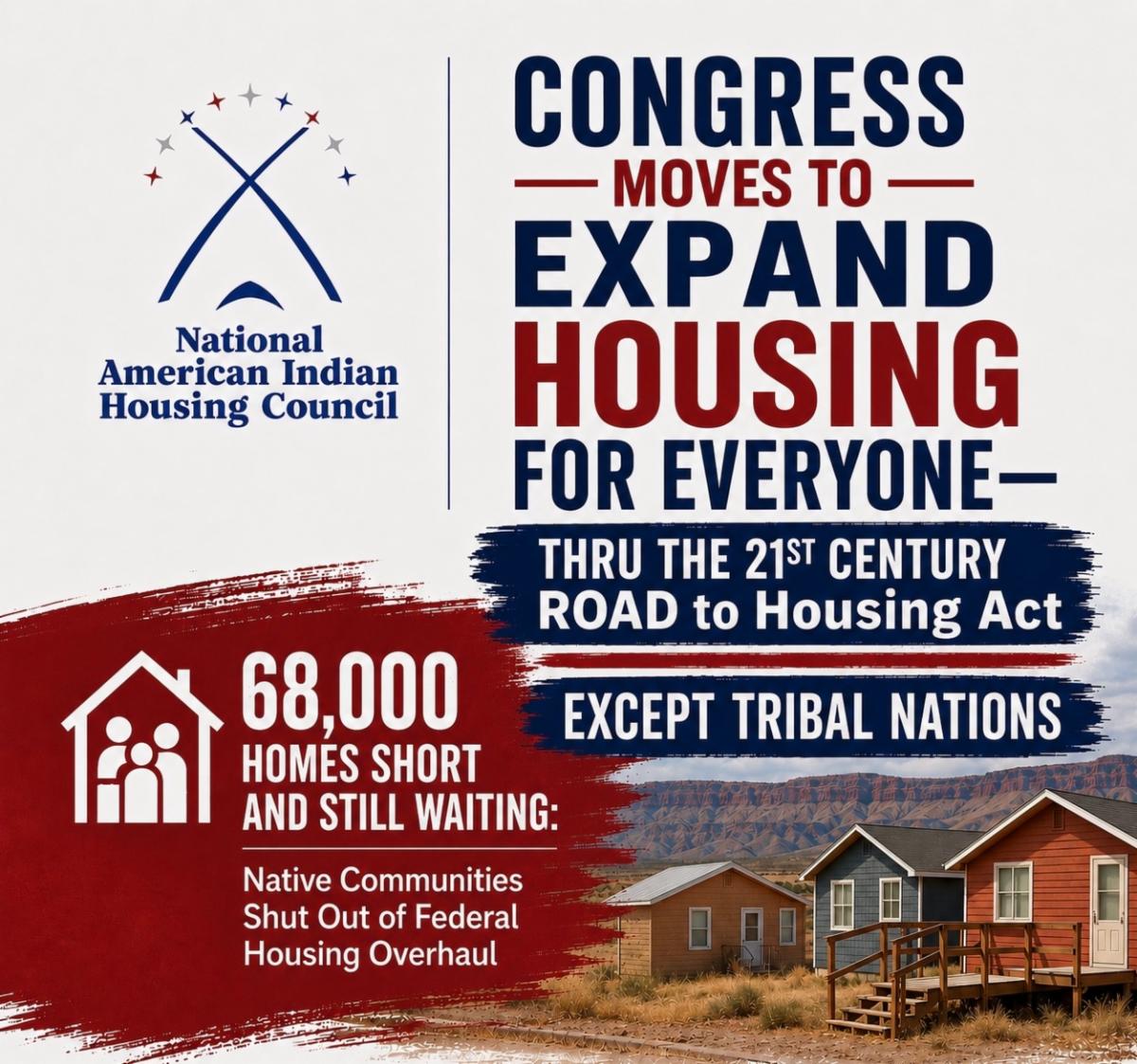
Last week, the U.S. House of Representatives passed H.R.1299, the “21st Century ROAD to Housing Act,” a sweeping housing package intended to expand housing supply, modernize federal housing programs, and address affordability challenges nationwide.
While the legislation includes several provisions that recognize Tribal eligibility and participation, the bill ultimately does not include meaningful improvements for Native American housing programs or modernization of the Native American Housing Assistance and Self-Determination Act (NAHASDA).
NAHASDA is the foundational federal statute through which HUD administers housing assistance to Tribal Nations — serving as the Native equivalent of the public housing authority system that supports non-Native communities across the country. Without its modernization, Tribal housing programs are operating under rules written nearly two decades ago while the rest of federal housing policy moves forward.
For Tribal housing advocates, the legislation represents both progress and a reminder that Indian Country continues to operate under outdated statutory authorities while broader federal housing programs benefit from modernization efforts.
Support NAIHC’s efforts to ensure Tribal Nations are not left out of this once-in-a-generation housing overhaul. Chip in today: Donate to Modernize NAHASDA Now
Key Takeaways for Tribal Housing Programs in H.R. 1299
H.R. 1299 contains several targeted provisions that include Tribal Nations and Tribally Designated Housing Entities (TDHEs) as eligible participants:
Whole-Home Repairs Program
One of the most significant Tribal-inclusive provisions within the bill is the creation of a Whole-Home Repairs Program. Under this section, Indian Tribes and TDHEs are explicitly identified as eligible entities that may partner with grantees to administer housing repair and rehabilitation activities as subrecipients.
Importantly, the eligible entities provisions formally reference the NAHASDA definitions of both “Indian Tribe” and “Tribally Designated Housing Entity” under 25 U.S.C. § 4103, reinforcing Tribal eligibility within the program structure.
Manufactured Home Community Revitalization Program
The legislation also establishes a Manufactured Home Community Revitalization Program that includes Indian Tribes among the eligible applicants for competitive grant funding.
In addition to general eligibility, the bill authorizes the HUD to establish set-asides specifically for Tribal Nations and TDHEs. Eligible applicants also include state and local governments, resident-owned communities, nonprofit organizations, and Community Development Financial Institutions (CDFIs).
Tribal Environmental Review Authority Expansion
The bill expands Tribal authority related to environmental review responsibilities under the National Environmental Policy Act (NEPA).
Specifically, the legislation amends federal law to add “Indian tribe” alongside states and units of local government as entities eligible to assume environmental review obligations. This provision is viewed as a meaningful regulatory streamlining measure that could help accelerate Tribal housing development timelines and reduce administrative burdens.
Housing Counseling Provisions
The legislation updates HUD housing counseling performance standards and oversight authorities. Tribes and TDHEs providing housing counseling services related to Section 184 guaranteed mortgages could be impacted by updated HUD review and compliance requirements.
What Is Missing?
Despite including a few Tribal-inclusive provisions, the House-passed legislation does not reauthorize NAHASDA, modernize the Indian Housing Block Grant (IHBG), or directly reform the Section 184 Loan Guarantee Program — omissions that Tribal housing advocates continue to identify as major gaps in the broader federal housing package.
NAHASDA has not been reauthorized since 2013, and the law itself has not undergone any changes since 2008. Meanwhile, Tribal housing programs continue to face escalating construction costs, infrastructure limitations, environmental review burdens, workforce shortages, supply chain disruptions, and severe overcrowding conditions across Indian Country.
Senate Consideration of the 21st Century Road to Housing Act
In response to these concerns, the National American Indian Housing Council (NAIHC) publicly welcomed bipartisan Senate efforts led by Senate Committee on Indian Affairs Chair Senator Lisa Murkowski (R-AK), Vice Chair Senator Brian Schatz (D-HI), and Senator Dan Sullivan (R-AK) that sought to incorporate Tribal housing priorities into the Senate’s version of the 21st Century Road to Housing Act.
The proposed amendments to the 21st Century Road to Housing Act in the Senate included:
- Allowing Tribes to raise income eligibility ceilings up to 120% of Area Median Income (AMI), while maintaining the majority of assistance for families below 80% AMI;
- Streamlining environmental reviews by allowing Tribes to rely on HUD environmental review approvals when NAHASDA or ICDBG funding serves as the primary financing source; (Consensus Support from NAIHC Board of Directors)
- Providing Tribal Nations and rural communities flexibility from certain Build America, Buy America (BABA) requirements due to unique supply chain and cost challenges in remote areas. (Consensus Support from NAIHC Board of Directors)
Chair Murkowski and Vice Chair Schatz emphasized that these proposed amendments represented practical and bipartisan solutions designed to help Tribal communities access the same modernized housing tools and efficiencies being extended to other federal housing programs.
However, Senate Banking, Housing, and Urban Affairs Committee Chair Senator Tim Scott (R-SC) and Senator Elizabeth Warren (D-MA) ultimately rejected inclusion of the Tribal housing provisions requested by Chair Murkowski and Vice Chair Schatz during negotiations surrounding the 21st Century Housing Act
The decision has increased concerns across Indian Country that Tribal housing programs are being redlined out during what lawmakers have described as a “once-in-a-generation” federal housing overhaul.
As NAIHC noted during Senate consideration of the package:
“Tribal housing cannot be left out of a once-in-a-generation overhaul. If you’re not at the table, you’re on the menu.” – Rudy Soto, NAIHC Executive Director
Native communities continue to experience some of the most severe housing conditions in the nation, including overcrowding rates estimated at nearly eight times the national average and a documented need for at least 68,000 additional housing units to relieve overcrowding and replace inadequate homes.
For Tribal housing advocates, the 21st Century Housing Act underscores both the importance and urgency of advancing standalone NAHASDA modernization legislation to ensure Tribal Nations are fully included in the future of federal housing policy.
NAIHC Continues Advocacy for NAHASDA Modernization
At the same time Congress advances broader national housing reform efforts, the National American Indian Housing Council (NAIHC) continues leading bipartisan advocacy efforts to ensure Tribal housing programs are not left behind.
Earlier this year, bipartisan congressional champions introduced standalone NAHASDA modernization legislation in both the House and Senate:
- H.R. 8092 — introduced by Representatives Troy Downing (R-MT) and Janelle Bynum (D-OR), with strong bipartisan momentum demonstrated through cosponsorship support from 27 Republicans and 18 Democrats representing 32 states across the country. See full list of cosponsors here
- S. 4276 — introduced by Senate Committee on Indian Affairs Chair Lisa Murkowski (R-AK) and Vice Chair Brian Schatz (D-HI) with additional bipartisan support from: Steve Daines (R-MT), Ben Ray Luján (D-NM), Dan Sullivan (R-AK), Mazie Hirono (D-HI), Mike Crapo (R-ID), Ruben Gallego (D-AZ)
The legislation seeks to:
- Reauthorize and modernize NAHASDA;
- Strengthen Tribal self-determination and flexibility;
- Improve and modernize Section 184 and 184A Loan Guarantee Programs;
- Streamline environmental review processes;
- Reduce administrative burdens and outdated regulatory barriers.
As Congress continues to work on21st Century Road to Housing Act, NAIHC remains actively engaged with key House and Senate offices, committee staff, Tribal organization leaders, and national housing partners to advocate for the inclusion of Tribal housing priorities in any final housing reform package.
Bottom Line
The House-passed 21st Century ROAD to Housing Act provides several important footholds for Tribal participation, particularly through:
- Whole-home repair programs,
- Manufactured housing revitalization grants,
- Expanded environmental review authority.
However, H.R. 1299 falls short of the Tribal housing modernization long needed by Indian Country.
Now is the time to stand with Tribal housing advocates and help ensure Native communities are fully included in the future of federal housing policy. Your contribution supports NAIHC’s advocacy, outreach, and national efforts to advance Tribal housing modernization.