
The 21st Century ROAD to Housing Act Is Now Law: What It Means for Tribal Housing
What the new law means for Tribal housing – and why congress must still pass the NAHASDA Modernization Act (H.R. 8092 / S. 4276)
What Happened
On July 11, 2026, the 21st Century ROAD to Housing Act became law. After the Senate passed the final bipartisan package 85-5 on June 22 and the House followed 358-32 on June 23, the bill was presented to the President on June 29. The President declined to sign it, and under Article I, Section 7 of the Constitution the bill automatically became law at the stroke of midnight when the ten-day window expired. It is widely described as the most comprehensive federal housing legislation enacted in decades.
What the New Law Does
The law is a broad housing reform package with more than 45 provisions aimed at increasing housing supply and lowering costs nationwide. Major elements include streamlined environmental reviews for housing projects, incentives for local zoning and land-use reform, expanded support for manufactured housing, restrictions on large institutional investors purchasing single-family homes, a three-year authorization of the CDBG Disaster Recovery program, and new pilot programs such as Whole-Home Repairs.
Where Tribal Communities Appear in the Law
The law includes Tribal communities in several places-but mostly as definitional mentions and as eligible participants within broader housing programs, not through a dedicated Tribal housing title or a NAHASDA reauthorization or modernization, even though NAHASDA is the primary federal law governing Tribal housing programs. Key Tribal references include:
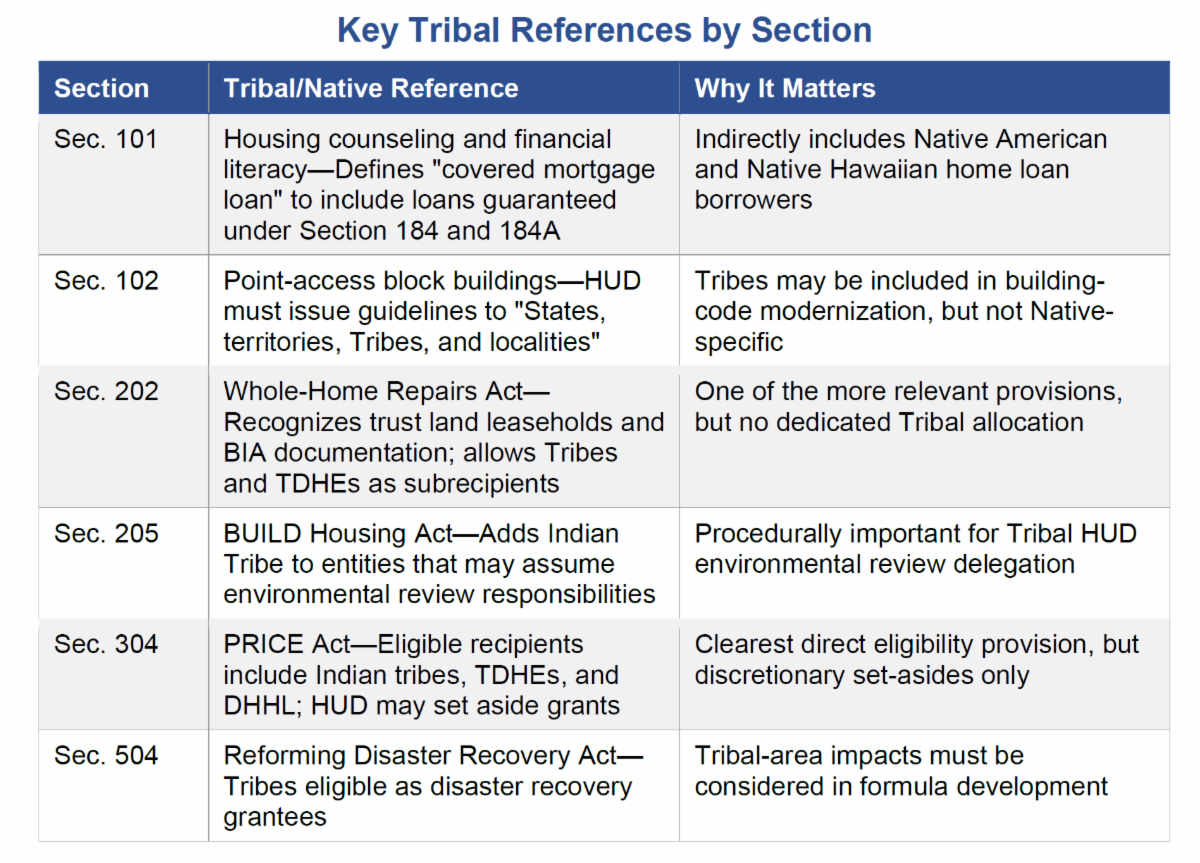
Overall, the law includes Tribal communities in four main ways: (1) eligibility-Tribes, TDHEs, Tribal governments, Tribal organizations, and DHHL are eligible or recognized in selected programs; (2) program coordination-several sections require or encourage coordination with Tribal programs or consideration of Tribal areas; (3) administrative recognition-the law references BIA documentation, trust land leaseholds, NAHASDA definitions, and Tribal environmental review authority; and (4) indirect Native homeownership references-Section 184 and 184A loans are included in housing counseling and foreclosure mitigation provisions.
What the Law Does Not Do
Recognizing Tribes as eligible participants in several programs is a positive step. But the new law does not fully address the unique legal and administrative challenges Tribal communities face, which will limit how much many Tribes can actually benefit. Specifically, the law:
• Contains no standalone Tribal housing title;
• Includes no NAHASDA reauthorization or modernization; and
• Fails to recognize that HUD’s Indian housing programs (IHBG and ICDBG) operate on fundamentally different statutory and regulatory frameworks than the programs being reformed throughout the law.
Meanwhile, Native American communities continue to experience some of the most severe housing shortages, overcrowding, infrastructure deficiencies, and unmet housing needs in the United States.
What Members Should Watch
As HUD begins implementation, NAIHC encourages Tribes and TDHEs to monitor the provisions where Tribal eligibility is clearest: PRICE Act set-asides for Tribes, TDHEs, and DHHL (Sec. 304); subrecipient eligibility under the new Whole-Home Repairs pilot (Sec. 202), which will still require future appropriations before funding flows; the option for Tribes to assume HUD environmental review responsibilities (Sec. 205); and Tribal eligibility in disaster recovery (Sec. 504). NAIHC will provide guidance and updates to members as HUD issues implementing rules and notices.
The Path Forward: Help Pass the NAHASDA Modernization Act
For more than 30 years, NAHASDA has been the foundation of federal Tribal housing policy. Tribal housing providers, Tribal leaders, and bipartisan Members of Congress have developed targeted reforms to strengthen program administration, improve housing development tools, reduce regulatory barriers, and expand housing opportunities in Indian Country. With the ROAD to Housing Act now law-without Tribal housing provisions at its core-Congress’s work is not finished.
NAIHC urges Congress to advance the bipartisan NAHASDA Modernization Act of 2026 (H.R. 8092 / S. 4276), introduced by Representatives Troy Downing (R-MT) and Janelle Bynum (D-OR) and Senators Lisa Murkowski (R-AK) and Brian Schatz (D-HI). These bills contain long-sought Tribal housing reforms developed in consultation with Tribal Nations, TDHEs, housing practitioners, and federal partners.
Take action:
Contact your congressional delegation and urge them to cosponsor and pass
H.R. 8092 and S. 4276. Tribal Nations deserve a meaningful seat at the table-and Tribal housing must not be left behind. You can also power NAIHC’s advocacy by contributing to the Modernize NAHASDA Now campaign: naihc.betterworld.org/campaigns/modernize-nahasda-now