
NAIHC Analysis of 21st Century ROAD to Housing Act
The National American Indian Housing Council (NAIHC) welcomes the 21st Century ROAD to Housing Act getting signed into law and urges Congress to ensure that Tribal housing priorities are fully incorporated into the nation’s housing agenda through advancement of the bipartisan NAHASDA Modernization Act.
The 21st Century ROAD to Housing Act represents one of the most significant housing reform packages considered by Congress in decades and contains several provisions that recognize Tribal communities as eligible participants in certain housing and community development programs. However, the legislation does not include a dedicated Tribal housing title, reauthorization of the Native American Housing Assistance and Self-Determination Act (NAHASDA), or targeted reforms to address the unique legal, regulatory, and administrative challenges facing Tribal housing providers.
“NAIHC supports the 21st Century ROAD to Housing Act and recognizes the potential benefits it could deliver for communities across the country. However, Tribal Nations continue to face some of the most severe housing shortages in America, and the legislation stops short of addressing the unique legal and administrative realities of Tribal housing programs,” said Rudy Soto, Executive Director of NAIHC.
NAIHC’s analysis found that among the most significant Tribal-related provisions are:
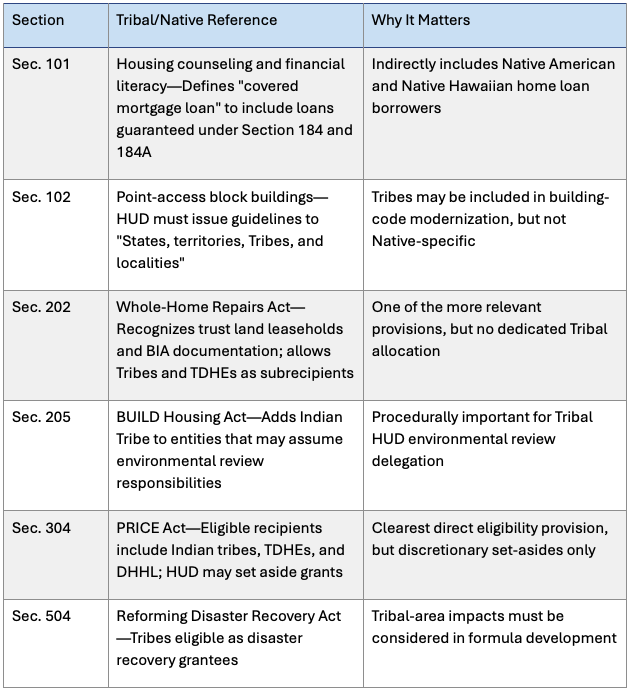
While these provisions represent positive steps, NAIHC notes that Tribal housing programs operate under fundamentally different statutory and regulatory frameworks than many of the federal housing programs addressed throughout the legislation.
Native American, Alaska Native, and Native Hawaiian communities continue to experience some of the most severe housing challenges in the United States, including chronic housing shortages, overcrowding, infrastructure deficiencies, and limited access to financing and development resources. For more than three decades, NAHASDA has served as the cornerstone of federal Tribal housing policy and has empowered Tribal Nations to design and administer housing programs consistent with principles of Tribal self-determination.
“We support the overall vision of the 21st Century ROAD to Housing Act and appreciate the bipartisan effort to expand housing opportunities nationwide,” Soto added. “Congress has an opportunity to build on this momentum by advancing the bipartisan NAHASDA Modernization Act and ensuring that Native American, Alaska Native, and Native Hawaiian communities share fully in the benefits of America’s housing investments.”
NAIHC is urging Congress to advance the bipartisan NAHASDA Modernization Act of 2026, H.R. 8092 and S. 4276, introduced by Representatives Troy Downing (R-MT) and Janelle Bynum (D-OR), and Senators Lisa Murkowski (R-AK) and Brian Schatz (D-HI). The legislation reflects years of consultation and collaboration among Tribal Nations, TDHEs, housing practitioners, federal partners, and bipartisan congressional leaders.
The NAHASDA Modernization Act would strengthen Tribal housing programs by improving administrative flexibility, expanding housing development tools, reducing regulatory barriers, and modernizing federal housing policies to better address the realities of housing development in Tribal communities.
As Congress continues its work on housing reform, NAIHC believes that advancing H.R. 8092 and S. 4276 represents the most direct and effective path toward addressing the unique housing needs of Native American, Alaska Native, and Native Hawaiian communities and ensuring that Tribal housing remains a national priority.