
National American Indian Housing Council
NAHASDA Modernization Advances to Senate Committee Markup and Vote
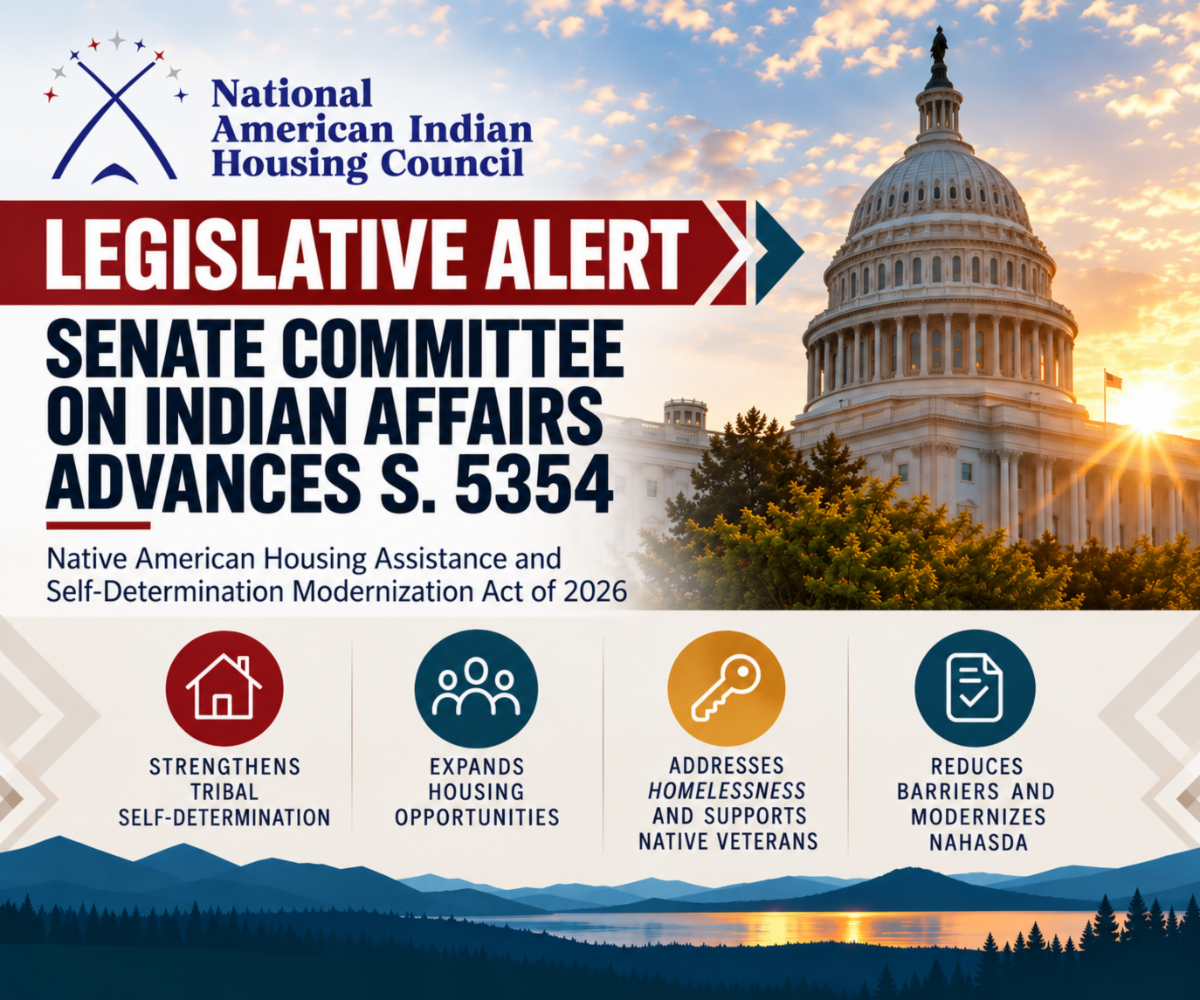
Today, the U.S. Senate Committee on Indian Affairs advanced S. 5354, the Native American Housing Assistance and Self-Determination Modernization Act of 2026, marking a significant step toward the first comprehensive reauthorization and modernization of the Native American Housing Assistance and Self-Determination Act (NAHASDA) in more than a decade.
Introduced by Senate Committee on Indian Affairs Chair Lisa Murkowski (R-AK) and Vice Chairman Brian Schatz (D-HI), S. 5354 would reauthorize NAHASDA programs through Fiscal Year 2033 while making substantial reforms intended to strengthen Tribal self-determination, reduce administrative barriers, expand homeownership opportunities, address homelessness, and give Tribes and Tribally Designated Housing Entities (TDHEs) greater flexibility to meet the unique housing needs of their communities.
The Committee’s action follows its September 16 oversight and legislative hearing, “Examining Housing Needs in Native Communities,” which included testimony on S. 5354 and the continuing housing challenges facing Tribal communities.
Committee Chair Lisa Murkowski (R-AK) expressed optimism about the opportunity to finally advance meaningful NAHASDA modernization:
“I am optimistic that as we work to advance this NAHASDA modernization, we will be moving the needle for the first time in a long time.”
Committee Vice Chairman Brian Schatz (D-HI) emphasized both the urgency of the housing crisis and the importance of maintaining NAHASDA’s foundation of Native self-determination:
“For Native families, housing is not just shelter; it is the foundation for everything else: their health, children’s education, and the chance to build a life close to home and culture. Right now, too many families in Indian Country, Alaska, and Hawaii are waiting, doubling up, or going without, and that’s why NAHASDA matters so much.”
Vice Chairman Schatz noted that S. 5354 builds on previous bipartisan efforts to reauthorize NAHASDA and provides Tribes and Native Hawaiians with additional tools, including lease-to-own pathways, stronger loan guarantees, and assistance for Native veterans and Native people experiencing homelessness.
“This modernization effort will help to make homeownership and stable housing a reality for more Native families in their homelands. I urge my colleagues to support this bill so we can pass NAHASDA out of the Senate for the second time.”
Senator Tina Smith (D-MN) underscored the federal government’s trust and treaty responsibilities and called for Congress to carry the legislation through both chambers:
“This is an act of good faith that Congress takes this step forward. Tribal Nations around the country, and certainly in Minnesota, look to us to pass this bill as a sign that we truly do take our trust and treaty responsibility seriously and that we understand fully what our obligations are as the government of the United States of America to live up to.” Senator Smith added: “I hope that we can not only pass this legislation out of the Committee, but that we can find a path forward all the way through the Senate and the House of Representatives too.”
NAIHC Executive Director Rudy Soto welcomed the Committee’s action:
“Today’s action represents meaningful progress toward finally modernizing NAHASDA and giving Tribal communities more of the tools and flexibility they need to address our housing challenges. For nearly 30 years, NAHASDA has served as the foundation of federal Tribal housing policy, but Indian Country’s housing needs have continued to grow while the law has gone more than a decade without comprehensive reauthorization.
We are deeply grateful to Chair Murkowski, Vice Chairman Schatz, Senator Smith, the members of the Senate Committee on Indian Affairs, and the Tribal leaders and housing advocates across Indian Country who have helped bring us to this point. This legislation strengthens Tribal self-determination, removes unnecessary barriers to housing development, expands opportunities for homeownership, and takes important new steps to address homelessness. This is significant progress, but our work is not finished. We look forward to working with our Senate champions to bring S. 5354 before the full Senate and with our partners in the House to move NAHASDA modernization across the finish line.”
Summary of S. 5354: Native American Housing Assistance and Self-Determination Modernization Act of 2026
S. 5354 reauthorizes the core Indian Housing Block Grant and Native Hawaiian housing programs for Fiscal Years 2027 through 2033 and makes extensive changes to NAHASDA and related federal housing programs.
New Initiatives
Tribal Homeless Housing Assistance: Establishes new assistance to address homelessness and housing instability among American Indians and Alaska Natives, expanding the federal tools available to Tribal communities to serve Native people experiencing or at risk of homelessness.
Native Hawaiian Homeless Housing Assistance: Establishes housing assistance specifically addressing Native Hawaiians experiencing or at risk of homelessness.
Tribal Continuum of Care Participation: Creates dedicated support to strengthen Tribal participation in HUD’s Continuum of Care system and improve Tribal access to federal homelessness resources.
Permanent Tribal HUD-VASH Program: Codifies Tribal HUD-VASH in federal law to provide rental assistance and supportive housing for homeless or at-risk Indian veterans. The legislation directs that not less than 5 percent of amounts made available for HUD-VASH rental assistance be used for the Tribal program.
Innovative Readiness Training Coordination: Requires HUD and the Department of Defense to coordinate with Tribes and TDHEs to maximize use of the Department of Defense Innovative Readiness Training Program for Tribal housing construction. The bill calls for a joint HUD-DOD memorandum of understanding, coordinated project planning, and guidance to help Tribes leverage the program.
Major Changes to Existing Programs
Environmental Review Streamlining: Significantly reforms environmental review requirements for Tribal housing projects. Among other provisions, the bill allows a single environmental review to satisfy requirements when multiple federal funding sources are involved, establishes a 60-day deadline for HUD action on certain waiver requests, and creates exemptions for specified activities, including certain affordable housing projects costing no more than $250,000 and qualifying rehabilitation projects.
Expanded Homeownership Eligibility: Allows recipients to use NAHASDA funds for homeownership assistance for Indian families with household incomes up to 120 percent of area median income, while limiting this expanded eligibility to no more than 20 percent of a recipient’s annual grant. Comparable flexibility is provided for Native Hawaiian homeownership assistance.
Greater Tribal Control Over Rent Policies: Allows recipients to establish their own written and publicly available policies governing maximum and minimum rents and homebuyer payments, including payments exceeding the existing 30-percent-of-adjusted-income standard.
Tribal Procurement Self-Determination: Allows NAHASDA recipients to adopt and follow their own written procurement policies and procedures for goods and services purchased with NAHASDA funds rather than relying exclusively on federal procurement standards.
Student Housing Assistance: Clarifies that eligible affordable housing activities may include college housing assistance, providing Tribes and TDHEs another tool to support Tribal members pursuing higher education.
99-Year Residential Leases: Extends the authorized leasehold interest for housing purposes on trust or restricted lands from 50 years to 99 years, supporting longer-term housing investment and financing.
Streamlined Reporting: Directs HUD to develop procedures allowing interested Tribes and TDHEs to submit one consolidated annual performance report covering NAHASDA grants and other HUD grant programs, reducing duplicative administrative requirements.
Housing Counseling Flexibility: Exempts Tribes, Tribal organizations, TDHEs, and the Department of Hawaiian Home Lands from mandatory HUD housing counseling certification requirements while preserving their ability to voluntarily obtain certification.
Total Development Cost Flexibility: Allows affordable housing developed, acquired, or assisted through the Indian Housing Block Grant program to exceed HUD’s total development cost maximum by up to 20 percent without prior HUD approval.
Expanded Tribal Access to Community Development Block Grant Activities: Authorizes Tribes—and Tribal organizations or TDHEs designated by Tribes—to directly carry out certain community development activities, including the new construction of affordable housing, without a percentage limitation on the amount of the grant that may be used for those activities.
Expanded Access to Housing Counseling Grants: Makes Indian Tribes and TDHEs expressly eligible to compete for federal housing counseling grants.
Section 184 Indian Home Loan Guarantee Program Modernization: Makes significant changes to Section 184, including clarifying eligibility for financing on trust and fee-simple lands, expressly including TDHEs, expanding eligible housing to 1-to-4-family dwellings, allowing qualified Community Development Financial Institutions to participate as lenders, and authorizing HUD to delegate direct guarantee endorsement authority to eligible lenders. The bill also provides authority for loan modifications of up to 40 years in certain circumstances.
Native Hawaiian Housing and Section 184A: Reauthorizes Native Hawaiian housing assistance through FY2033 and modernizes the Section 184A Native Hawaiian Housing Loan Guarantee Program, including expanded homeownership opportunities on fee-simple lands and lender and loan-processing reforms similar to those made to Section 184.
Next Steps: Take Action
Committee approval represents a major milestone, but S. 5354 must still advance through the full U.S. Senate, and NAHASDA modernization must advance through the House of Representatives, before legislation can reach the President’s desk.
NAIHC will continue working with Tribal leaders, TDHEs, regional Tribal housing associations, national partners, and congressional champions to build support for final passage. Tribal housing advocates can help maintain this momentum by contacting their congressional delegations and urging them to cosponsor and pass S. 5354 in the Senate and H.R. 8092 in the House before the end of the 119th Congress.
To support these efforts, NAIHC has developed a suite of advocacy tools and resources, including bill text, section-by-section materials, one-pagers, sample letters to Congress, a House-Senate comparison chart, information on key congressional committees, fact sheets, and NAHASDA webinars.
Access NAIHC’s Tribal Housing Advocacy Tools & Resources
Advocates can also help power NAIHC’s continued outreach and education efforts by contributing to the Modernize NAHASDA Now campaign: Support the Modernize NAHASDA Now Campaign